
Workplace Safety and Health: Current Challenges and the Tools to Support SMEs
Interview by Angela Lim on CNA's prime-time news programme, following the Singapore WSH Conference 2026.
Watch on YouTubeProfessor of Safety & Performance of Engineering Systems · Civil Engineering Department, DUTH · Xanthi, Greece
I study how complex engineering and socio-technical systems migrate towards unsafe states, and how systems theory and artificial intelligence can reveal the hazards early.

Ioannis M. Dokas is Professor of Safety and Performance of Engineering Systems in the Civil Engineering Department of the Democritus University of Thrace (DUTH), where he leads research on systems safety and resilience at the Risk and Resilience Research Centre (RiskAC).
He holds a Diploma in Civil Engineering and a PhD on the provision of early-warning services for infrastructures using web-based expert systems. A two-time recipient of EU Marie Curie fellowships, he spent eight years at leading research institutes in Germany and Ireland.
His work brings systems theory, and increasingly artificial intelligence, to the analysis of hazards, accidents and resilience across critical infrastructure: transport systems, water systems, construction sites and disaster response. He served on the Editorial Board of Safety Science (Elsevier) from 2020 to June 2026, and is a member of the IFIP Working Group on IT in Disaster Risk Reduction. Within his department, he serves as Director of the Sector of Mathematics, Programming and General Courses (since September 2023, with a seat on the Departmental Board) and as Director of the Laboratory of Project Organization and Management (since September 2024).
Much of my research applies and extends the STAMP accident-causation model and STPA hazard analysis by Prof. Nancy Leveson, which treat safety as a control problem and accidents as the result of inadequate control, rather than of simple component failure. Together with my doctoral researchers, and under my guidance, we have developed a family of methodologies and tools that make this kind of analysis more rigorous, more quantitative and, most recently, AI-assisted.
A methodological blueprint for evaluating large language models in safety-critical hazard analysis. It maps the gaps in current LLM benchmarks and introduces "Performance Consistency" as a new evaluation metric, tested across nine safety-critical scenarios.
Safety Science, 2026 ↗A systematic study of how useful large language models such as ChatGPT-4 can be in STPA hazard analysis: mapping where AI genuinely supports the analyst and where human expertise remains essential.
Safety Science, 2024 ↗A multi-agent LLM framework that automates the systematic classification of STPA context-table rows as safe or unsafe — a labor-intensive bottleneck in safety analysis. Combines schema-validated outputs with a two-stage, self-correcting evaluation under constraint-based validation by a separate agent.
ESWC / NTCA 2026, IEEE ↗A fuzzy-logic extension of the RealTSL methodology that reduces the effect of imprecise and uncertain data when measuring the safety level of socio-technical systems.
Safety, 2024 ↗A STAMP-based methodology, with a full mathematical model, that calculates how safe a system is at any given moment, turning systems-theoretic safety into a quantity that can be monitored in real time.
Safety Science, 2022 ↗A theoretic framework that couples STPA with Markov decision processes to support safe decision-making in human–robot collaborative tasks.
A methodology for identifying loopholes in emergency response plans and determining their completeness value, so that gaps are found before an emergency does.
A methodology and indicator that measures whether a complex socio-technical system is equipped to be aware of its own safety issues, grounded in the STAMP model.
STAMP Workshop research ↗An Early Warning Sign identification Approach that extends STPA, helping analysts systematically pinpoint the observable signs that a hazard is developing.
Safety Science, 2013 ↗Speaking in Symposium 2B on artificial intelligence and autonomous systems in workplace safety and health.
Organising the 11th IFIP WG5.15 Conference on Information Technology in Disaster Risk Reduction, 29 September – 1 October 2026.
Two papers from the research group presented at the 12th European STAMP Workshop and Conference (ESWC 2026), co-located with the 2026 New Trends in Civil Aviation conference (NTCA), 22–24 April 2026: From Subsystems to Mission Control: A Dynamic ORM Framework Integrating STPA-T, EWaSAP, and Real-Time Safety Levels (with PhD candidate N. A. Vasileiadis) and Multi-Agent LLM Classification of STPA Context Tables (with I. Katranas and G. C. E. Kafoutis). Both published in IEEE Xplore.
Co-organising a public festival on climate resilience, part of the CARE_X climate-risk project.
Advising and training large organisations on risk and hazard analysis, incident and accident investigation, and the development of safety management systems, among other safety topics.
Director of the Sector of Mathematics, Programming and General Courses since September 2023 (two consecutive terms, with a seat on the Departmental Board), and Director of the Laboratory of Project Organization and Management since September 2024.
Over the past three years, invited to give talks at ten international conferences and professional events on systems safety and AI (in Singapore, Greece, North Macedonia, Latvia and Slovenia), among them the Singapore WSH Conference, the 18th Maintenance Forum, the 1st Balkan Health & Safety at Work Congress, and the Latvian State Labour Inspectorate's conference on AI in public administration, alongside online events such as the ENSHPO webinar on AI in occupational safety. Most recently (9 September 2026), a guest lecture on safety, hazard recognition and risk management, and accident prevention, in the DUTH KEDIVIM programme on laboratory training in inspection, repair and strengthening techniques for existing structures.
Recognised by the Democritus University of Thrace for excellence in undergraduate teaching.
Serving on the Board of Directors, as Treasurer, of FEX, a non-profit cultural and educational organisation founded in 1952. One of the most active such institutions in northern Greece, FEX runs the Folklore & Historical Museum of Xanthi and organises festivals, workshops and cultural programmes for the city.
Served on the Board of Directors of Management Force Group, a Greek company specialising in occupational health and safety, from 2020 until June 2026.
Served as handling editor for the journal from 2020 until June 2026, reviewing research on systems safety and risk.
Active in the CARE_X climate-risk project (funded through the CLIMAAX framework), COST Action ANTICIPATE, and "Pioneers for AI in Natural Disasters", a free AI-education programme run with the technology NGO SciFY.
A centre for the Region of East Macedonia & Thrace assessing multi-hazard risk and resilience. Funded under NSRF 2014–2020 (ERDF), budget ≈ €2.0M.
A regional climate-risk and resilience project funded through the CLIMAAX framework, the European platform supporting regional climate risk assessment. Includes public engagement such as the Xanthi Resilience Festival.
A free training programme created by the technology NGO SciFY together with the Democritus University of Thrace, supported by the John S. Latsis Public Benefit Foundation. Building on SciFY's UNESCO-awarded "Pioneers for AI", it equips students and young graduates with skills in using artificial intelligence for the prevention and management of natural disasters.
Cross-border cooperation project under Interreg V-A Greece–Bulgaria 2014–2020.
Funded by the Irish Environmental Protection Agency: foundational work on early-warning services for critical infrastructure.
No publications match your search.
An introduction to geodetic concepts and surveying activities for first-year undergraduate civil engineering students.
Methods and tools for structured decision-making in the management of engineering projects and businesses, including decision analysis under uncertainty.
Foundations of environmental management for civil engineers, co-taught with colleagues from the department.
The equipment used on construction sites and the organisation of site work, with particular attention to safety and the preparation of construction safety plans.
Economic analysis of engineering projects: time value of money, project evaluation, depreciation, and decision-making under financial criteria.
Introduces students to the main categories of accident models and hazard analysis techniques, with a focus on the STAMP accident model and STPA hazard analysis.
An introduction to solid waste management for senior students, who build a system-dynamics model of the waste system serving a virtual city.
Autonomous teaching since 2021. The course covers the operational side of civil protection and the management of crises arising from hydrometeorological hazards.
Co-taught since 2022. The course introduces postgraduate students from management backgrounds to systems-theoretic approaches to safety and risk in organisations.
Autonomous teaching since 2026 in the inter-institutional MATBA programme, based at the Department of Tourism Economics and Management of the University of the Aegean. The course covers safety, security and crisis management in the air transport sector.
Detailed course descriptions and materials (slides, exercises and videos) are available through the DUTH eClass service.
Interview by Angela Lim on CNA's prime-time news programme, following the Singapore WSH Conference 2026.
Watch on YouTube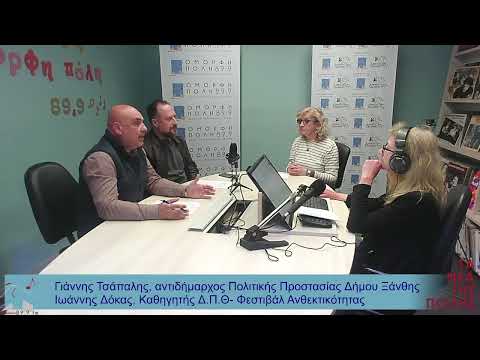
Joint interview with the Deputy Mayor for Civil Protection of Xanthi on the 1st Resilience Festival (Xanthi, 8–10 May 2026): climate-change awareness, education and preparedness of the local community.
Watch on YouTube
Statement to Maron News at the event "Crisis and Natural Disaster Management: The Day After".
Watch on YouTube
Report on the Career Day hosted at the Civil Engineering Department, DUTH (Xanthi, 24 October 2023).
Watch on YouTube

Talk at the 5th Security Project Conference, Divani Caravel, Athens.
Watch on YouTubeOpen to collaboration, doctoral supervision, and speaking on systems safety and resilience.